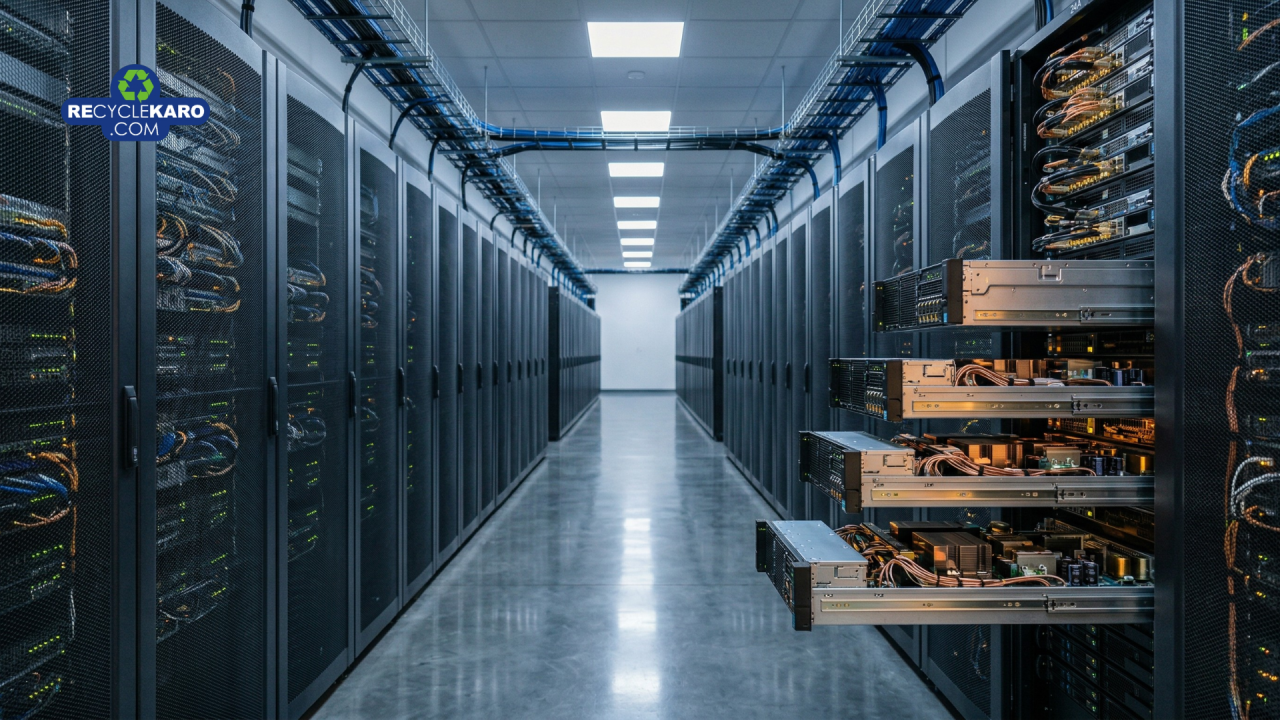
What Is Data Center E-Waste Recycling?
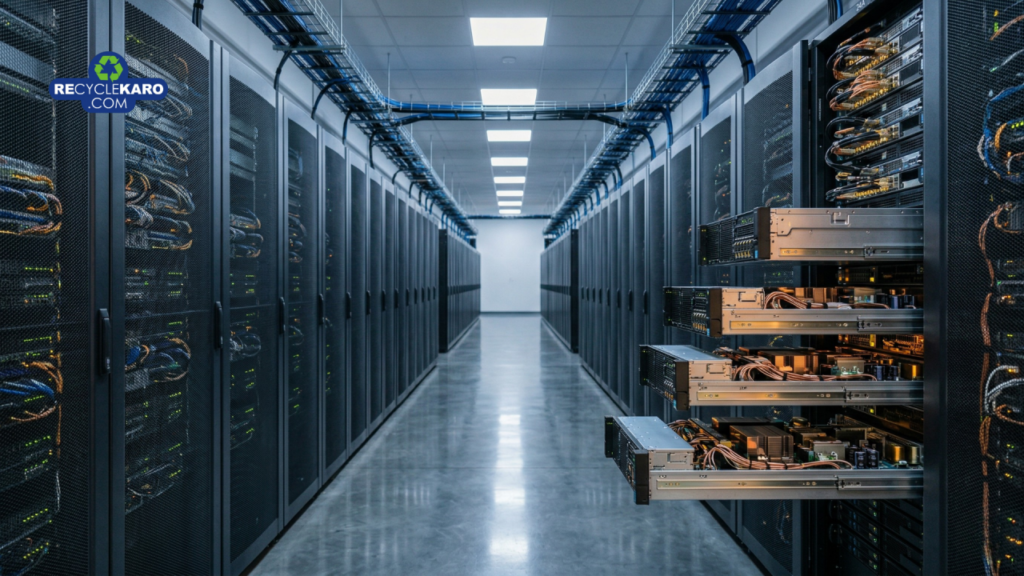
Data center e-waste recycling is the process of recovering critical and rare earth materials including neodymium, cobalt, copper, gold, and lithium, from decommissioned servers, hard drives, GPUs, and cooling systems.
Unlike consumer electronics, data center hardware is standardized, replaced in predictable cycles, and contains rare earth concentrations up to 500 times higher than natural ore deposits. As India’s data center capacity grows under digital infrastructure mandates, recycling this waste stream has become a direct pathway to domestic critical mineral supply, reducing dependence on Chinese rare earth imports, which currently account for 80–90% of India’s requirement.
Every decommissioned server rack is a concentrated deposit of neodymium, dysprosium, cobalt, and gold already mined, refined, and assembled. The only question is whether India builds the infrastructure to recover it.
Why Data Center E-Waste Is Growing Faster Than Anyone Planned
AI has broken the hardware lifecycle model that data center operators spent a decade building. Traditional enterprise servers ran for five to six years before retirement. GPU-intensive AI workloads have compressed that to two to three years, hardware purchased in 2022 was often unsuitable for its original purpose by 2025 [CITE: STS Electronic Recycling, 2026].
AI compute racks now draw 20–60 kilowatts per rack versus 5–10 kilowatts for legacy servers, forcing facilities to choose between expensive retrofits or wholesale decommissioning
The volume consequence is significant:
|
Metric |
Figure |
Source |
|---|---|---|
|
DC equipment reaching end-of-life globally (2025) |
68 million units |
DataIntelo ITAD Report |
|
Retired servers needing disposition annually (2026) |
~16.8 million units |
DataIntelo ITAD Report |
|
Global DC decommissioning market (2026) |
$12.95 billion |
Research & Markets |
|
YoY market growth rate |
7.37% |
Research & Markets |
|
Data centers with zero e-waste recycling |
12% |
Supermicro / Human-I-T |
|
Data centers with no e-waste policy |
43% |
Supermicro / Human-I-T |
[CITE: DataIntelo ITAD Report] [CITE: Human-I-T, March 2026]
For India, these numbers represent a double problem: high-value materials lost to informal processing, and a formal recycling infrastructure that has historically been undersized for the volume it needs to absorb.
What Data Center Hardware Actually Contains
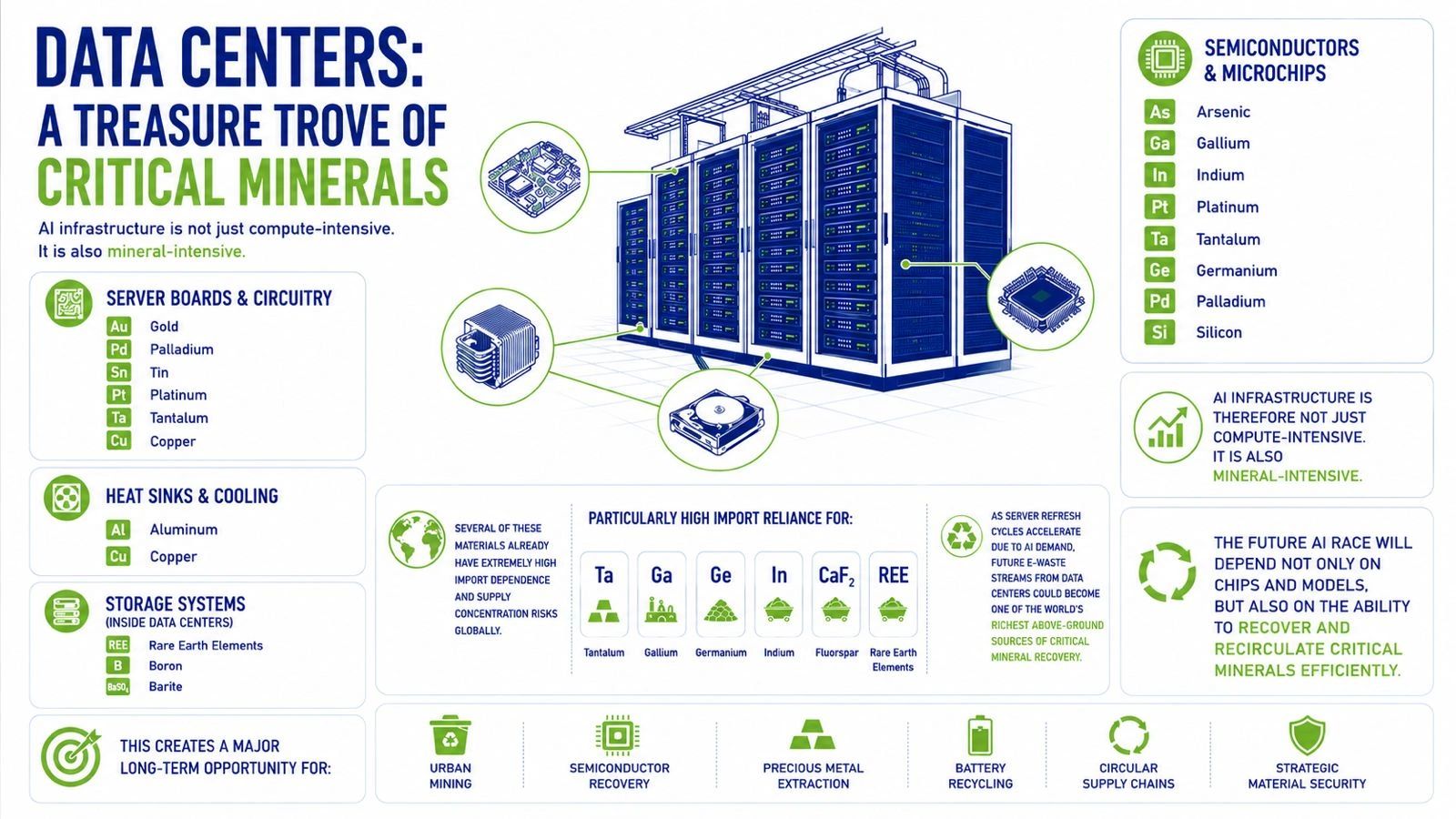
The material profile of a decommissioned data center is richer than most operators realize and strategically more significant than any consumer electronics stream.
Material Breakdown by Hardware Type
|
Hardware Component |
Key Materials |
Strategic Significance |
|---|---|---|
|
HDD actuators & fan motors |
NdFeB magnets: neodymium, dysprosium, praseodymium, terbium |
Critical for EV motors, wind turbines, defense |
|
GPU accelerators |
Gold, silver, palladium, cobalt, terbium (cooling) |
AI compute core; high precious metal density |
|
Server PCBs |
Gold, silver, palladium, copper |
Precious metal concentration 3–5x consumer electronics |
|
UPS / battery backup units |
Lithium, cobalt, nickel |
Direct overlap with EV battery supply chain |
|
Chassis, power systems, cabling |
Copper, aluminum, steel |
High-volume base metal recovery |
|
Cooling systems (specialty) |
Samarium, scandium, yttrium |
Rare earth elements in some configurations |
The single most strategically significant material class is rare earth elements in NdFeB permanent magnets. There is no engineering substitute for neodymium or dysprosium in high-performance EV traction motors or wind turbine generators. Every kilogram recovered from a decommissioned data center is a kilogram India does not need to import.
Industry analyses indicate REE concentrations in e-waste are 40 to 500 times higher per kilogram than natural ore deposits [Discovery Alert / Resource Recycling Inc., 2026].
In the US alone, $4 billion is lost annually to unrecovered precious metals in discarded computer equipment [CELI/Medium, December 2024]. India faces a comparable loss, compounded by the fact that the country reimports these same refined materials to supply its electronics manufacturing sector.
The ESG Compliance Angle: Where This Shows Up in Your Reporting
Data center hardware disposal is not a peripheral sustainability issue for Indian enterprises, it is a reportable Scope 3 liability under the GHG Protocol and SEBI’s BRSR Core framework.
|
GHG Protocol Category |
What It Covers |
Recycling Data Required |
|---|---|---|
|
Scope 3, Category 5 |
Waste Generated in Operations |
Mass-balance data: kg diverted from landfill, recycled, recovered |
|
Scope 3, Category 12 |
End-of-Life Treatment of Sold Products |
Chain-of-custody certificates from certified recycler |
Without an R2v3-certified recycling partner supplying verified mass-balance documentation, enterprises cannot substantiate their Scope 3 hardware disposal claims in audited ESG disclosures. With SEBI’s BRSR Core expanding mandatory reporting requirements for listed entities, this is a compliance gap, not a voluntary reporting choice.
The benchmark is set: Microsoft’s Circular Centers program achieved 90.9% server reuse and recycling in FY2024, exceeding its 2025 target ahead of schedule [CITE: Microsoft, 2024].
Oracle reached 99.6%. These outcomes reflect standard decommissioning protocols built around certified ITAD and recycling partners from the outset.
How the Recycling Process Works: Decommission to Battery-Grade Output
Authorized data center e-waste recycling follows four stages. Each stage requires specific technical capability and regulatory authorization.
Stage 1 — Secure Data Destruction (ITAD)
Hardware is sanitized to NIST SP 800-88 standards or physically destroyed, with certificates of data destruction issued for every asset. Choosing a CPCB-authorized recycler who also provides ITAD eliminates split compliance chains and reduces documentation overhead.
Read More:
Stage 2 — Dismantling and Sorting
Servers are manually disassembled to isolate high-value subcomponents: PCBs, HDD assemblies with NdFeB magnets, UPS battery packs, and chassis metals. Manual dismantling preserves component integrity that bulk shredding would destroy. AI-enabled robotic sorting systems are increasingly used to identify and separate materials at throughput levels that manual processing cannot match.
Stage 3 — Hydrometallurgical Extraction
NdFeB magnets are dissolved in acidic solutions and individual rare earth elements separated through selective leaching and solvent extraction recovering neodymium, dysprosium, and praseodymium suitable for new magnet production. PCB fractions undergo targeted hydrometallurgical processing for gold, silver, and palladium recovery.
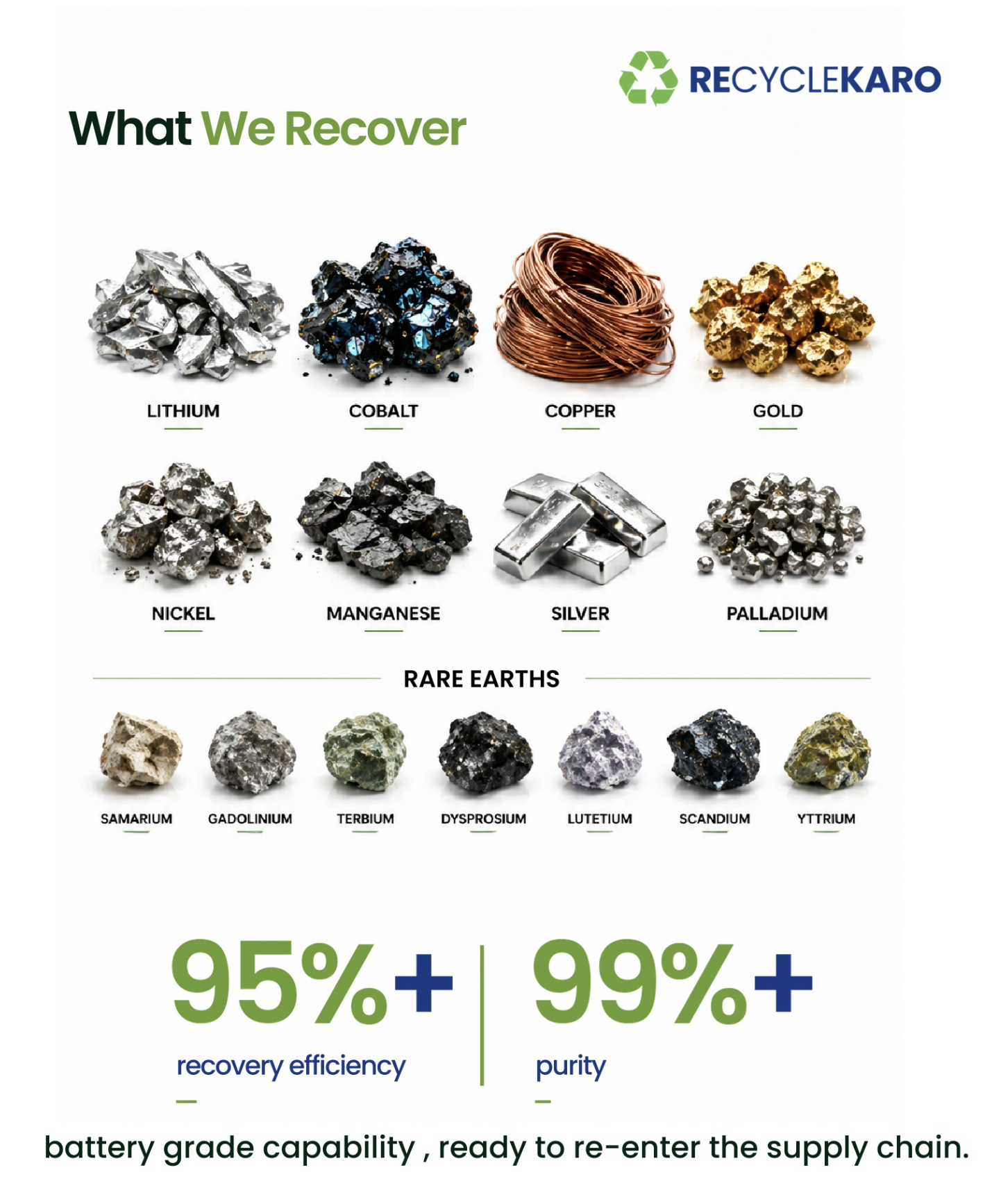
RecycleKaro’s patented lithium extraction process recovers cobalt sulphate, nickel sulphate, and lithium carbonate from battery-containing e-waste including data center UPS systems at 95%+ recovery efficiency and 99%+ output purity.
Stage 4 — Battery-Grade Output and Supply Chain Re-Entry
The end product is specification-grade commercial material, not scrap. Cobalt sulphate, lithium carbonate, and neodymium oxide recovered by RecycleKaro re-enter manufacturing supply chains at the same purity specification as primary mined material. This is the distinction between authorized industrial recycling and informal processing: the output is a supply chain input, not a residue.
India’s Rare Earth Exposure And What Data Center Recycling Changes
India sources 80–90% of its rare earth elements and permanent magnets from China approximately $221 million in imports in 2025 [D+C Development + Cooperation, April 2026].
Global REE recycling rates remain below 1% [Earth.org, 2026]. These two facts define the strategic opportunity.
|
Indicator |
Figure |
|---|---|
|
India’s REE import dependence (China) |
80–90% |
|
India’s REE imports from China (2025) |
~$221 million |
|
India’s rank among global e-waste producers |
3rd largest (UN figures) |
|
India’s annual e-waste generation (2026) |
~3.2 million MT |
|
Share processed through authorized channels |
~10% |
|
REE demand potentially met via e-waste recycling (scaled up) |
Up to 70% |
|
NCMM critical mineral recycling incentive (2025) |
₹1,500 crore over 6 years |
[D+C, April 2026] [CITE: Context by TRF / Reuters, October 2025] [CITE: ORF Online, March 2026]
Data center hardware is the highest-quality feedstock in the urban mining opportunity -standardized, traceable, and available in growing volumes as India’s hyperscaler-driven infrastructure build-out matures.
The E-Waste Management Rules 2022 already mandate EPR compliance for data center operators; the National Critical Minerals Mission (2025) signals that REE-specific recycling incentives are coming. The policy direction is clear, what is needed is the processing infrastructure to match it.
REE Concentration: E-Waste vs. Primary Ore
|
Source |
Neodymium Concentration |
Recovery Complexity |
|---|---|---|
|
Mountain Pass ore (USA) |
~80,000 ppm |
High — mining + beneficiation + refining |
|
Bayan Obo ore (China) |
~60,000 ppm |
High — complex mixed deposit |
|
NdFeB magnets (e-waste) |
~240,000–300,000 ppm |
Medium — standardized alloy, known chemistry |
|
HDD magnet assemblies |
~290,000+ ppm |
Low-Medium — discrete components, automated separation possible |
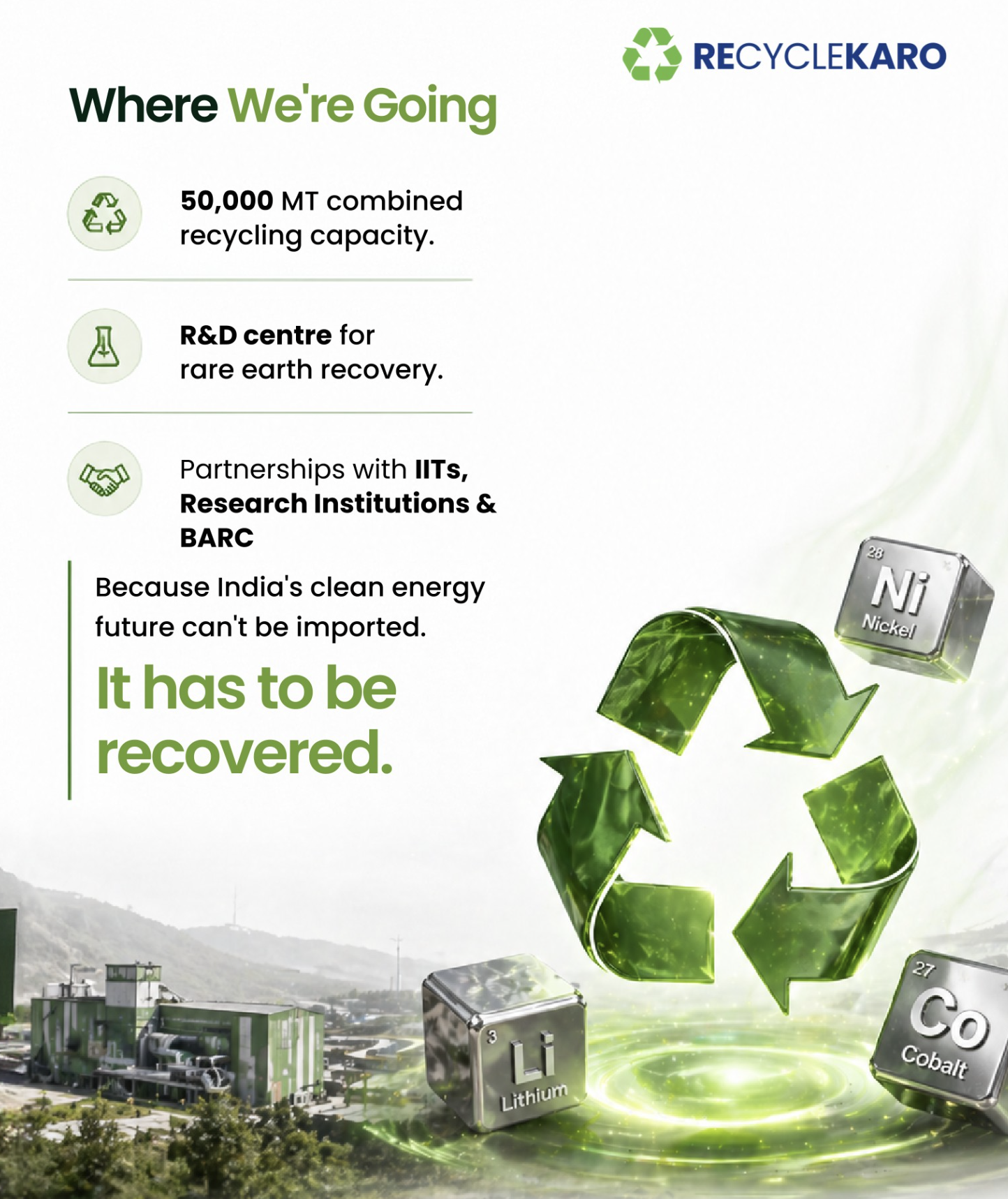
The concentration advantage is substantial. The processing challenge is real but solvable — and RecycleKaro’s R&D partnerships with IITs and BARC are directly advancing India’s domestic capability to close that gap.
RecycleKaro: India’s Authorized Partner for Data Center E-Waste Recycling
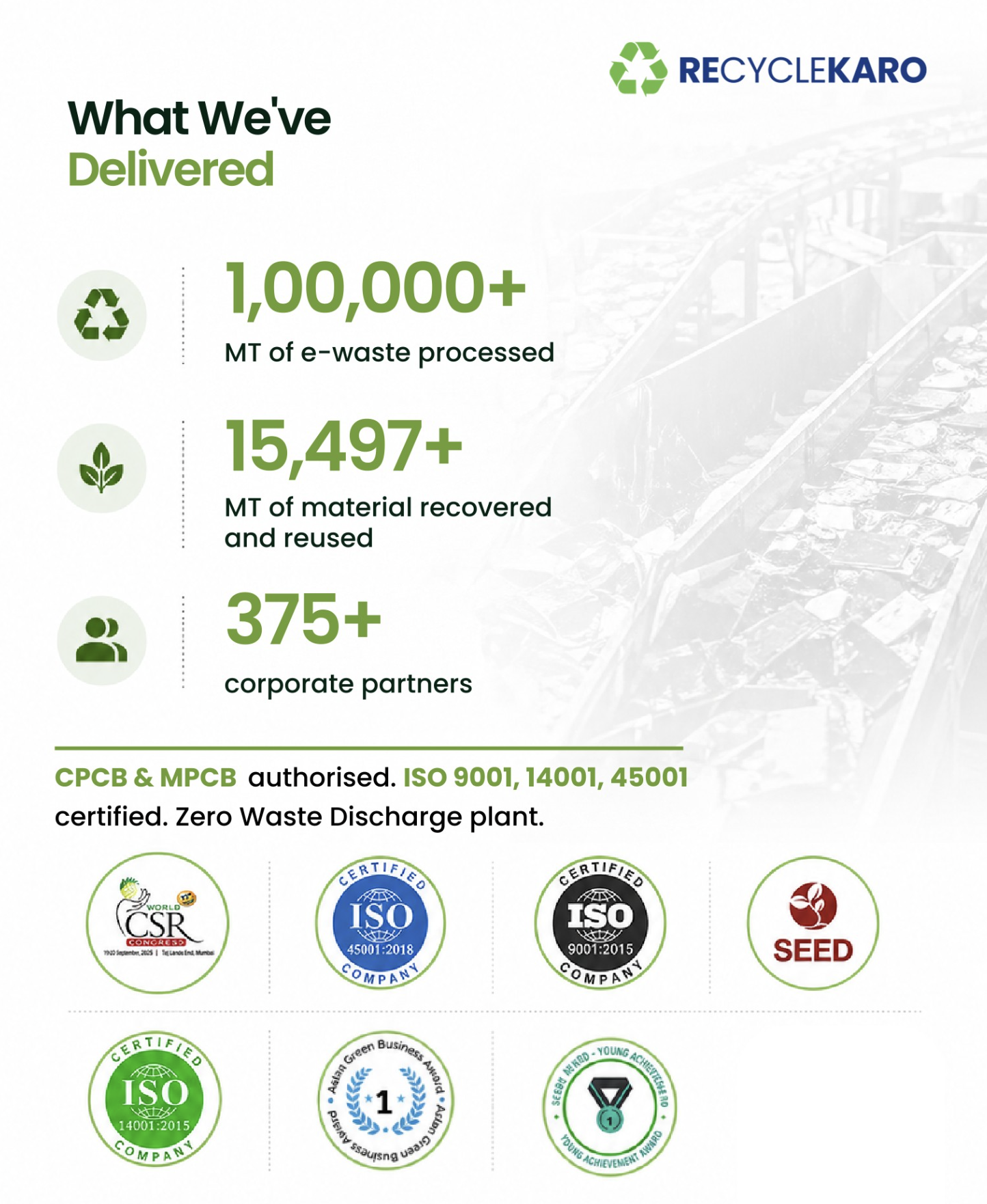
RecycleKaro – Evergreen RecycleKaro India Limited, is India’s leading end-to-end e-waste recycling facility and the country’s largest recycled cobalt manufacturer.
Facility and Scale
|
Metric |
Figure |
|---|---|
|
E-waste processed (total) |
1,00,000+ MT |
|
Material recovered and reused |
15,497+ MT |
|
Corporate partners |
375+ |
|
Facility size |
17 acres |
|
Workforce |
300+ people |
|
Collection touchpoints across India |
12,000+ |
|
Years of operation |
15+ |
What RecycleKaro Recovers from Data Center Hardware
- Rare earths: samarium, gadolinium, terbium, dysprosium, lutetium, scandium, yttrium
- Battery-critical metals: cobalt sulphate, nickel sulphate, lithium carbonate
- Precious metals: gold, silver, palladium
- Base metals: copper, aluminum, nickel, manganese