
What Is a Battery Energy Storage System and How Does It Work?
A BESS stores electrical energy in rechargeable battery cells and releases it when demand requires it. It functions as a buffer between generation and consumption, absorbing surplus power when supply exceeds demand and injecting it back when demand outpaces supply.
How the cycle works:
During charging, an AC/DC converter draws power from a solar array, wind plant, or the grid and delivers it to the battery cells. In lithium-ion cells, lithium ions migrate from cathode to anode through the electrolyte. The BMS monitors every cell: voltage, temperature, state of charge, preventing overcharge and thermal runaway.
During discharge, ions reverse direction, releasing electrons as electrical current. The PCS converts DC to AC for grid or load delivery. The EMS determines timing and rate, responding to price signals, grid frequency events, or operator instructions.
Round-trip efficiency for modern lithium-ion BESS systems sits at 85–95%, depending on chemistry, thermal conditions, and system integration quality.
Key Components at a Glance
|
Component |
Function |
|---|---|
|
Battery Cells |
Core storage – electrochemical reactions store and release energy |
|
Battery Management System (BMS) |
Monitors voltage, temperature, SoC; prevents dangerous operating conditions |
|
Power Conversion System (PCS) |
Converts DC ↔ AC between battery and grid |
|
Energy Management System (EMS) |
Controls dispatch strategy against price, grid, and demand signals |
|
Thermal Management System |
Keeps cells within safe temperature range, critical for cycle life |
|
Fire Suppression System |
Mandatory for commercial deployments; detects and suppresses thermal events |
Component integration, especially BMS and EMS quality, matters as much as cell chemistry. A premium cell with a poor BMS degrades faster than a well-integrated mid-range system.
Types of Battery Energy Storage Systems
LFP vs. NMC: The Two Chemistries Dominating India
Lithium Iron Phosphate (LFP) is the default choice for grid-scale BESS in India. It offers 3,000–6,000 cycle life, superior thermal stability, and lower cost because it contains no cobalt or nickel. Lower energy density is the trade-off, irrelevant for stationary applications where weight doesn’t matter. India’s first large commercial BESS, the 20 MW / 40 MWh Kilokri project in Delhi, is LFP.
Lithium Nickel Manganese Cobalt Oxide (NMC) delivers higher energy density preferred for space-constrained commercial installations and EV charging infrastructure. NMC contains cobalt and nickel, which raises upfront cost but significantly increases end-of-life recovery value. A recycled NMC pack yields battery-grade cobalt sulphate and nickel sulphate, high-value materials that re-enter cell manufacturing.
|
Chemistry |
Cycle Life |
Safety |
Cobalt/Nickel |
End-of-Life Value |
|---|---|---|---|---|
|
LFP |
3,000–6,000 |
High |
None |
Moderate |
|
NMC |
1,000–3,000 |
Medium |
Yes |
High |
|
Vanadium Flow |
10,000+ |
High |
None |
High (vanadium reusable) |
|
Lead-Acid |
500–1,000 |
Medium |
None |
Moderate |
|
Sodium-Ion |
2,000–4,000 |
High |
None |
Low (emerging) |
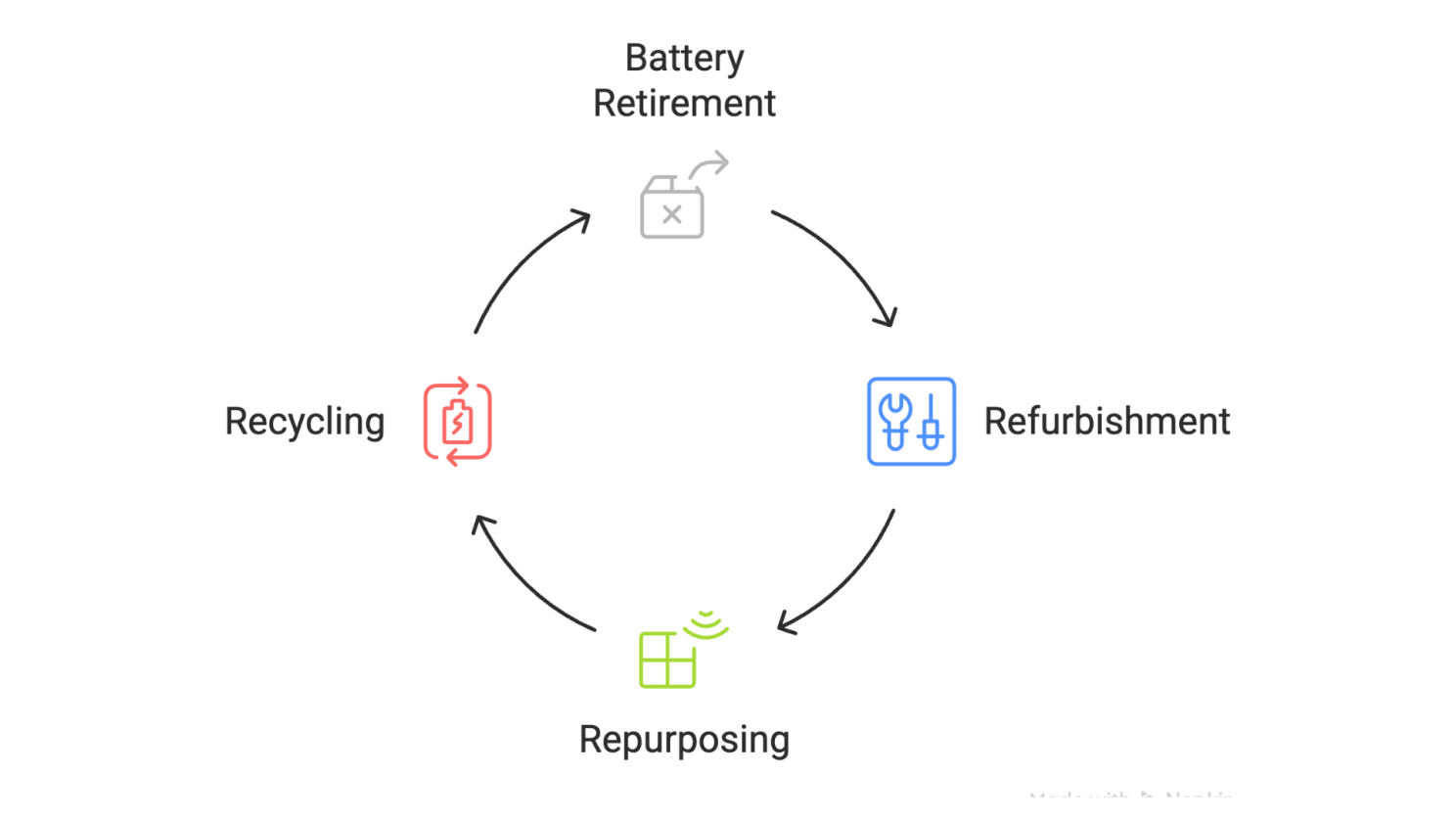
Most lithium-ion BESS systems carry a 10–15 year operational warranty. When State of Health (SoH) drops to 70–80%, the pack reaches a decision point: second-life stationary reuse, or material recovery through certified recycling. India’s BWMR now formally governs both pathways.
Applications of BESS in India
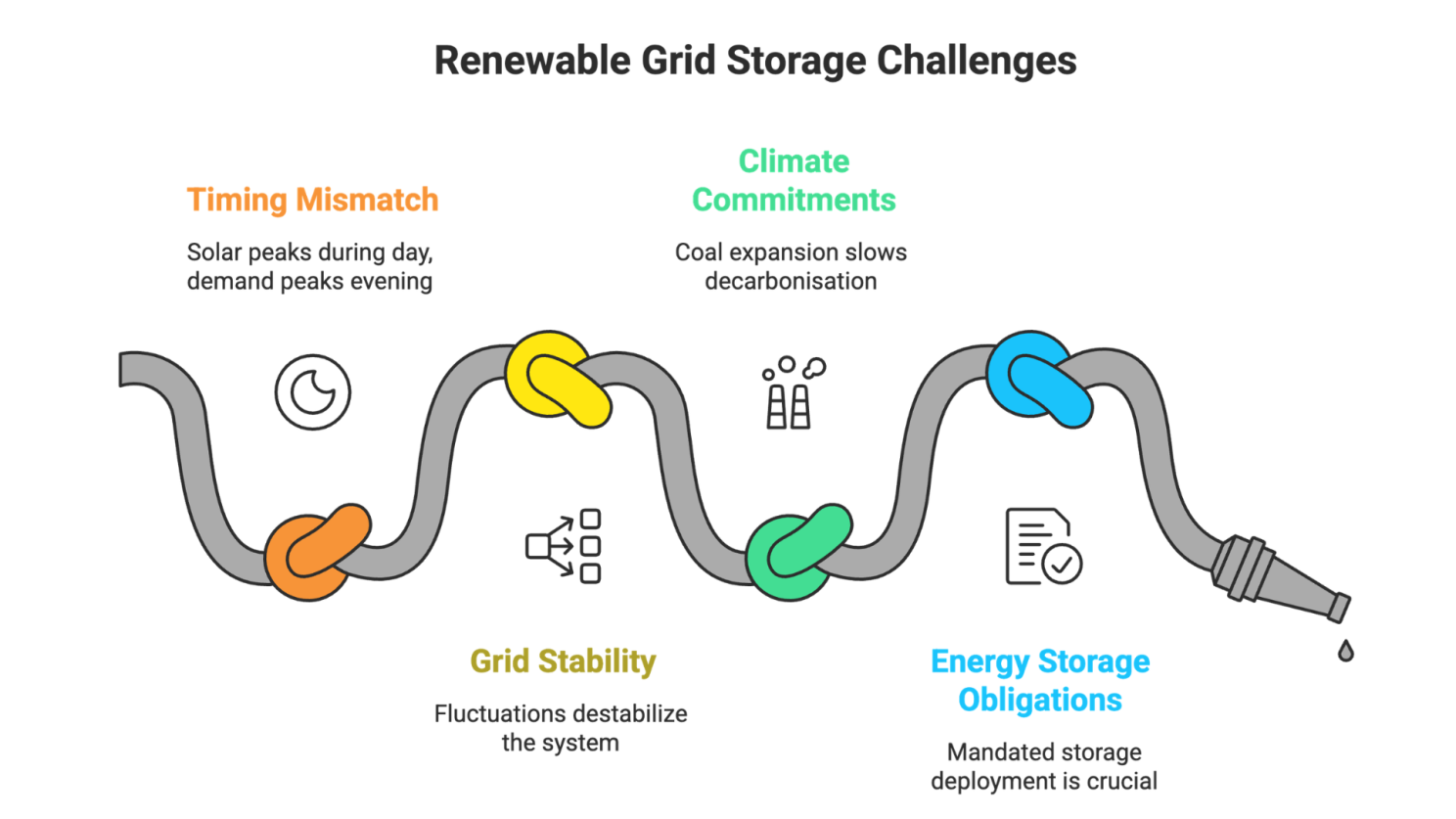
- Renewable Energy Integration: Solar peaks at noon; demand peaks in the evening. A BESS time-shifts that energy, charging during the solar surplus and discharging into the evening peak, eliminating curtailment and maximizing asset utilization. Hybrid renewable tenders in India grew from 12% of total RE tenders in 2021 to over 49% in 2024. Storage is now a specified project requirement.
- Grid Frequency Regulation: A BESS responds to frequency deviations within milliseconds — injecting power before any thermal plant can ramp. This Fast Frequency Response capability is essential for India’s grid as renewable penetration increases and the risk of frequency instability grows.
- Energy Arbitrage: India’s Day Ahead Market price volatility — driven by midday solar surpluses — has created real arbitrage opportunity. One independent analysis found that a BESS installed in 2024 can achieve a 17% IRR from energy arbitrage alone.
- C&I Peak Shaving: For large manufacturers, data centers, and EV charging operators, a behind-the-meter BESS reduces peak demand charges — often the dominant line item in commercial electricity bills — and provides backup power during outages.
Battery Energy Storage System in India: Market, Policy & Costs
Market Size
India’s BESS market was valued at approximately USD 306 million in 2024, projected to reach USD 1.2–2.3 billion by 2030–2033 at a 25–27% CAGR. The pipeline is the sharper signal: 92 GWh as of early 2026, driven by 69 tenders covering 102 GWh of capacity issued in 2025 alone, more than the cumulative total from 2018 through 2024. India is expected to commission 5 GWh in 2026, the first year of meaningful utility-scale deployment.
Government Policy
National Framework for Energy Storage Systems gave BESS legal status as grid infrastructure and introduced energy storage obligations for distribution companies and RE developers.
Viability Gap Funding (VGF) supports 4,000 MWh of BESS installations through 2030–31, covering up to 40% of capital cost — the mechanism that made India’s first utility-scale BESS projects bankable.
ISTS Charge Waiver exempts hybrid renewable-plus-storage projects from inter-state transmission charges, reducing effective project cost.
PLI Scheme for Advanced Chemistry Cells incentivizes domestic lithium-ion cell manufacturing, reducing import dependence and building the supply chain BESS projects require.
Cost and ROI
Installed BESS costs in India currently range from ₹12,000–₹22,000/kWh for utility-scale systems to ₹18,000–₹32,000/kWh for commercial installations. Battery cells — 50–60% of installed cost — have fallen over 90% globally in the past decade. As PLI-backed manufacturing scales, Indian costs are converging with international benchmarks.
For C&I users, peak demand charge reduction typically delivers the fastest payback. For utility developers, arbitrage stacked with ancillary services revenue produces IRRs now attracting serious project finance interest.
What Happens to BESS Batteries at End of Life? India’s Recycling Imperative
BWMR 2022 and 2025: Legal Obligations Every BESS Developer Must Know
India’s Battery Waste Management Rules created a comprehensive EPR framework covering all battery types — including every lithium-ion cell in every BESS project.
Key obligations:
- Producers (manufacturers and importers) must register on the CPCB EPR portal and meet annual collection and recycling targets
- End-of-life packs must go to CPCB-authorized recyclers only — unregistered operators generate zero valid EPR credit
- Authorized recyclers must achieve 90% material recovery from processed lithium-ion batteries by 2026–27
- From FY 2027–28, new batteries manufactured in India must incorporate minimum percentages of recycled lithium, cobalt, and nickel from domestically processed end-of-life packs
- Second-life applications (stationary storage) are formally recognized under BWMR 2025; refurbishers must register on the CPCB portal
Producers who miss EPR targets face Environmental Compensation penalties. Only authorized recyclers issue valid EPR credit certificates, there is no compliant workaround.
Read More: EPR Compliance in India
What Critical Minerals Does BESS Recycling Recover?
End-of-life BESS packs are not waste. They are a concentrated source of critical minerals India currently imports at significant cost:
- Cobalt → cobalt sulphate (highest-value output from NMC recycling)
- Nickel → nickel sulphate (critical for NMC cathode manufacturing)
- Lithium → lithium carbonate or lithium hydroxide
- Copper, Manganese, Aluminum, Graphite → secondary streams
- Rare earths (from mixed streams) → Samarium, Gadolinium, Terbium, Dysprosium, Lutetium, Scandium, Yttrium
India currently recycles only around 1% of its end-of-life lithium-ion batteries. With scaled certified recycling, that industry could reach ₹31,150 crore by 2030.
RecycleKaro’s hydrometallurgical process at its 17-acre Palghar, Maharashtra facility recovers all the above at 95%+ efficiency and 99%+ output purity, battery-grade material that re-enters the supply chain without further refinement. This positions RecycleKaro as India’s largest recycled cobalt manufacturer, with enterprise clients including Bajaj Auto, Tata Motors, Hero MotoCorp, and Ather Energy.
Why Certification Determines Your EPR Compliance Position
Only CPCB-authorized recyclers generate valid EPR credit certificates. Sending packs to an unregistered operator retains full penalty exposure with zero compliance credit.
Certification also determines output grade. A certified facility with verified recovery efficiency returns battery-grade minerals to high-value supply chains. An uncertified operator produces low-grade scrap.
RecycleKaro holds: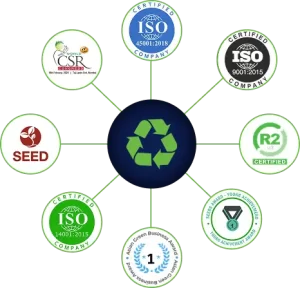
- CPCB authorization
- MPCB authorization
- ISO 9001:2015
- ISO 14001:2015
- ISO 45001:2018
- R2v3 certification (highest global standard for electronics and battery recycling)
- Zero Waste Discharge plant status.
With 15+ years of operation, 300+ trained specialists, and 12,000+ collection touchpoints across India, RecycleKaro operates at the scale BESS fleet recycling demands.
Before signing with any recycling partner, ask: Are you on the CPCB EPR portal? What is your verified recovery rate? Can you provide battery-grade output specs and an EPR credit audit trail?
A battery energy storage system is no longer a future technology for India, it is infrastructure being commissioned right now. The 92 GWh pipeline and the government’s 500 GW renewable target by 2030 guarantee that India will deploy more BESS capacity in the next five years than in the past decade.
That deployment creates an obligation that cannot be deferred: a certified, compliant end-of-life strategy. India’s BWMR has made this a legal requirement. The project developers, OEMs, and sustainability teams that plan battery recycling at procurement — not when packs expire — will recover critical mineral value, meet EPR targets without penalty, and contribute to India’s domestic battery supply chain.
RecycleKaro processes end-of-life lithium-ion batteries through a patented hydrometallurgical process at its Palghar facility – India’s largest recycled cobalt producer, certified by CPCB, MPCB, ISO, and R2v3. Start the recycling conversation before your batteries do.
Frequently Asked Questions
1. What is a battery energy storage system?
A BESS stores electrical energy in rechargeable batteries and discharges it on demand to balance supply and demand. Key components are battery cells, a BMS, a PCS, and an EMS. Systems scale from residential units of a few kWh to utility installations of hundreds of MWh.
2. Which BESS chemistry is best for India?
LFP dominates utility-scale and grid-connected BESS in India due to its long cycle life, thermal stability, and lower cost. NMC is preferred where energy density matters and where end-of-life cobalt and nickel recovery value is part of the project economics.
3. What is India’s BESS market size?
USD 306 million in 2024, projected to reach USD 1.2–2.3 billion by 2030–2033 at a 25–27% CAGR. The pipeline stands at 92 GWh as of early 2026, with 5 GWh of commissioning expected in 2026.
4. What EPR obligations apply to BESS batteries in India?
Under BWMR 2022/2025, producers must register on the CPCB portal and meet recycling targets. End-of-life batteries must go to CPCB-authorized recyclers achieving 90% material recovery. From FY 2027–28, new batteries must contain minimum percentages of domestically recycled materials.
5. Which minerals are recovered from recycled BESS batteries?
Lithium (as lithium carbonate), cobalt (as cobalt sulphate), nickel (as nickel sulphate), manganese, copper, and graphite. RecycleKaro’s patented hydrometallurgical process achieves 95%+ recovery efficiency and 99%+ output purity at battery-grade specification.