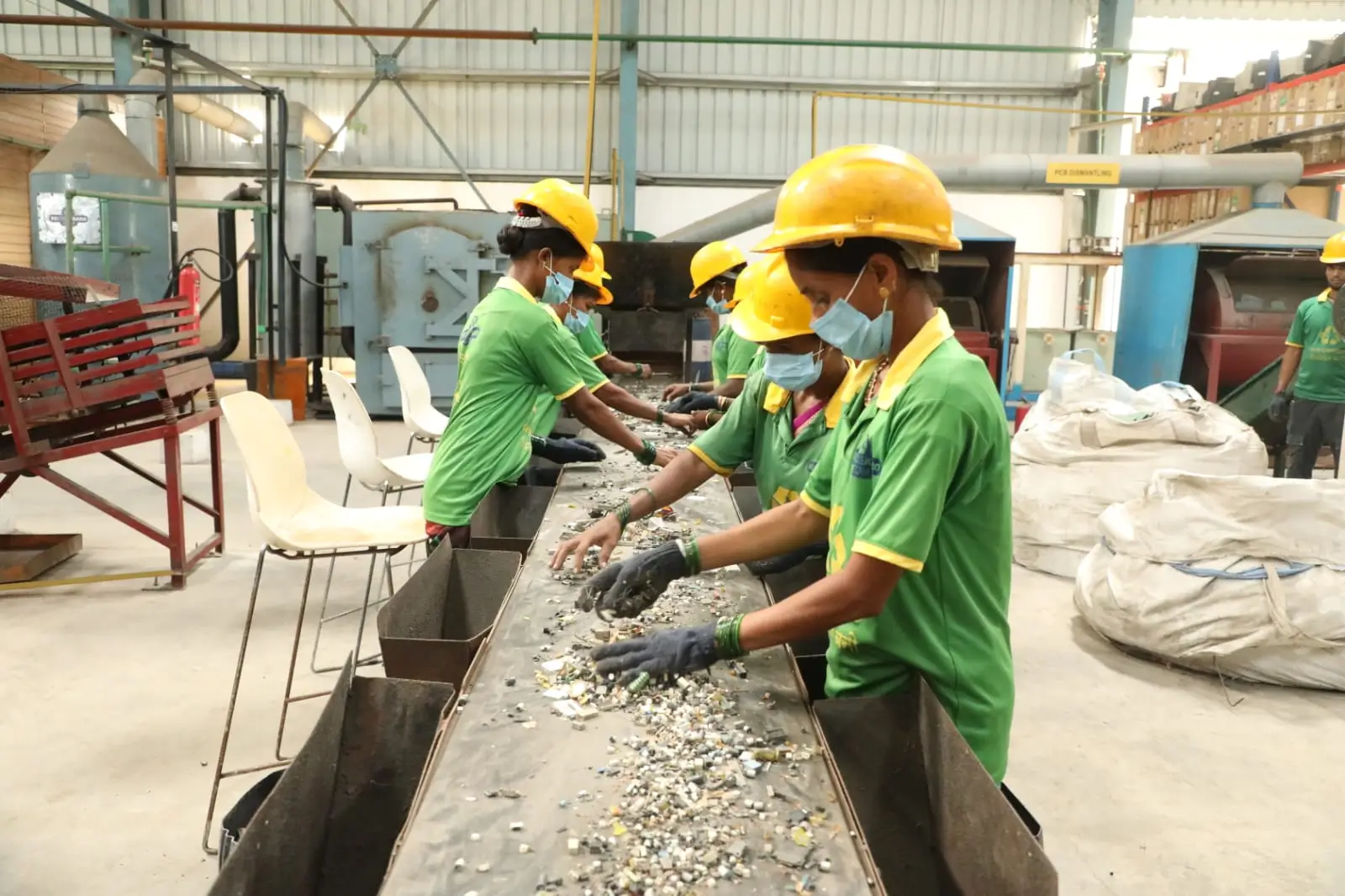
India generated over 1.6 million tonnes of e-waste in 2023, making it the third-largest e-waste producer in the world, according to the Global E-Waste Monitor 2024. Yet only a fraction of that volume passes through formal, authorized recycling channels. The rest is processed by an informal sector that uses acid baths, open burning, and uncontrolled dismantling practices that are not just environmentally destructive but actively create legal exposure for the companies that unknowingly use them.
For procurement and sustainability leaders at Indian enterprises, the stakes of a bad recycling partnership are higher than most realize. A recycling certificate from an informal or non-compliant processor is not a compliance document — it is a liability. And with India’s E-Waste Management Rules, 2022 (MoEFCC) tightening Extended Producer Responsibility obligations, the audit risk of getting this wrong has never been greater.
This checklist gives you the evaluation framework that India’s most rigorous procurement teams use when vetting e-waste recycling partners. It is built around five non-negotiable criteria, a 20-question vendor scorecard, and a clear set of red flags that no credible recycler should trigger.
Why choosing the wrong e-waste recycler is a bigger compliance risk than choosing none at all
Most companies approach e-waste recycling as a disposal problem. Get the old laptops out of the office, hand them to someone with a certificate, file the paperwork. The assumption is that any certified-looking vendor closes the compliance loop.
That assumption is wrong — and increasingly dangerous.
Under India’s E-Waste Management Rules, 2022, the obligation doesn’t end at collection. Producers and bulk consumers are responsible for ensuring their e-waste reaches an authorized recycler that actually processes the material through compliant methods. Handing equipment to an intermediary who subcontracts to informal processors — a common practice in India’s recycling supply chain — does not discharge that obligation. The certificate you receive may look legitimate. The CPCB portal may even show the collecting company as authorized. But if that material never reaches a qualified facility for actual processing, your compliance documentation is worthless in an audit.
The consequence isn’t just a failed audit. Under the E-Waste Rules, non-compliance can trigger penalties, mandatory corrective action, and for listed companies, disclosure requirements under SEBI’s Business Responsibility and Sustainability Reporting (BRSR) framework that go well beyond the recycling transaction itself.
The right question to ask isn’t “does this company have a certificate?” It’s “can this company prove what happened to my material after it left my premises?” Very few recyclers operating in India can answer that question with verified data.
The 5 non-negotiable criteria every B2B buyer should verify
Across 15+ years of operating India’s most advanced battery and e-waste recycling infrastructure processing over 1,00,000 MT of e-waste and serving 375+ corporate partners including Bajaj Auto and Tata Motors, the RecycleKaro compliance team has identified five criteria that consistently separate credible recyclers from those who cannot withstand scrutiny.
- CPCB and state PCB authorization – what it means and how to verify it
Authorization from the Central Pollution Control Board (CPCB) is the baseline requirement for any e-waste recycler operating in India. But authorization is not binary, it specifies the categories of e-waste a facility is permitted to handle, the volumes authorized, and the geography of operation. A recycler authorized to handle IT hardware is not automatically authorized to handle batteries.
State Pollution Control Board (PCB) authorization is a separate and equally mandatory requirement under the E-Waste Management Rules, 2022. A company with CPCB authorization but no state PCB clearance is operating in a compliance gap.
How to verify: Ask the vendor for their CPCB authorization number and cross-reference it directly on the CPCB official portal at cpcb.nic.in. This takes three minutes and eliminates approximately 40% of vendors who claim authorization they do not hold. Also request the state PCB authorization letter — a legitimate recycler will provide this immediately. -
Technology capability – plasma furnace, hydrometallurgy, or informal shredding?
This is the criterion that no competitor in the Indian e-waste recycling space discusses openly because most cannot pass it.
There is a fundamental difference between a recycling company that collects and shreds e-waste (commodity processing) and one that operates advanced material recovery technology. The difference matters to you for two reasons: the quality of compliance documentation you receive, and the environmental outcome you can report.
Informal and semi-formal recyclers typically shred and sort – they recover bulk metals at low purity and sell them as scrap. The process generates hazardous residues that are often landfilled or illegally dumped. There is no output purity data because the output is undifferentiated scrap.
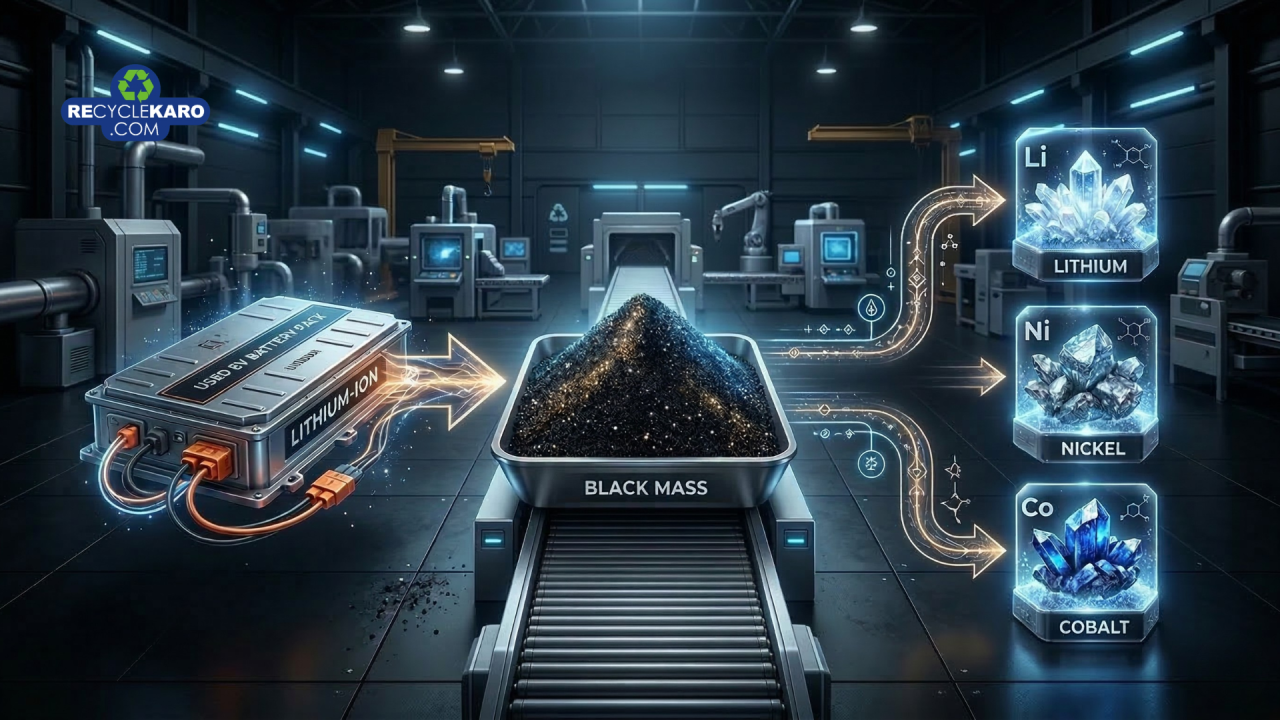
Advanced formal recyclers — those operating hydrometallurgical processes, plasma furnaces, or patented extraction systems recover specific materials at defined purity levels: cobalt sulphate, nickel sulphate, lithium compounds, copper at 99%+ purity. These outputs can re-enter battery and electronics manufacturing directly. This is not just better for the environment, it is the only processing pathway that produces the material recovery documentation required for BRSR Scope 3 reporting and recycled content mandates under India’s evolving battery regulations.
What to ask: “What is your primary processing technology? Can you share a process flow diagram?” A credible operator will answer without hesitation. An evasive or vague response is a disqualifying signal. -
Output quality benchmarks – what 95%+ recovery efficiency and 99%+ purity actually mean
When a recycler claims high recovery efficiency, ask them to define it. Recovery efficiency measures the percentage of material value successfully extracted from the input waste stream. A 95%+ recovery rate means that for every 100 units of recoverable material entering the process, 95 or more are successfully extracted rather than lost to waste streams. This is a meaningful operational benchmark that separates advanced facilities from basic shredders.
Output purity is the complementary measure – it describes the concentration of the target material in the recovered product. Cobalt sulphate at 99%+ purity is battery-grade and can re-enter manufacturing directly. Cobalt at 70% purity is a low-value intermediate that requires further refining before it can re-enter the supply chain.
For your procurement process, output quality benchmarks serve two functions. First, they verify that the recycler is actually processing material rather than storing or subcontracting it. Second, they give your ESG team quantified avoided-emissions data, the mass of virgin material that your recycled output displaces, which is the basis for Scope 3 Category 12 calculations under the SEBI BRSR framework. -
Certifications that matter and what to look past
Certifications are a necessary starting point, not a sufficient conclusion. The following certifications are meaningful and should be verified:-
ISO 14001:2015 — Environmental Management System. Confirms the facility operates with documented environmental controls. Requires third-party audits.
-
ISO 45001:2018 — Occupational Health and Safety. Relevant for worker safety in dismantling and chemical processing environments.
-
ISO 9001:2015 — Quality Management System. Confirms documented process controls.
-
R2v3 Certification — Responsible Recycling Standard, version 3. The most rigorous international standard for electronics recycling. Requires verified data security, environmental compliance, and downstream accountability.
-
CPCB and State PCB Authorization — as discussed above, both are mandatory, not optional.
-
- Documentation and audit trail – what your compliance certificate must contain
A legitimate recycling certificate is a verifiable document, not a receipt. Under the E-Waste Management Rules, 2022, documentation must enable traceability from the point of collection through to final processing. If your certificate cannot answer the questions an MoEFCC or CPCB auditor will ask, it will not protect you.
A compliant certificate must include all of the following:- Total weight of material collected (in metric tonnes), with date and location of collection
- CPCB authorization number of the collecting entity and the processing facility (these may differ)
- Processing methodology used (e.g., hydrometallurgy, pyrometallurgy, mechanical shredding)
- Chain-of-custody tracking – who took possession of the material at each transfer point
- Name and signature of the authorized officer at the processing facility
- Material recovery summary – what was recovered, in what quantities, at what purity levels
If a recycler cannot provide all six elements on a post-processing certificate, the documentation will not survive a regulatory audit. Ask to see a sample certificate before signing any service agreement.
Red flags: 6 signs your e-waste vendor is cutting corners
Each of the following is a disqualifying signal. If a vendor triggers even one, request explicit written documentation to resolve it before proceeding. If they cannot resolve it, do not proceed.
- They cannot tell you where your material goes after collection. Only informal processors and unaccountable brokers operate without downstream traceability. A legitimate facility can name the processing site, provide its CPCB authorization number, and explain the specific processes applied.
- The recycling certificate does not name a processing methodology or authorized officer. A weight-in receipt is not a compliance document. If the certificate does not specify how the material was processed and who authorized the processing, it will not withstand regulatory scrutiny.
- They cannot provide output purity data or material recovery reports. This is the clearest indicator of informal or commodity-level processing. Any facility performing genuine material recovery can produce third-party assay data. Refusal or inability to provide this data means the material was either stored, sold as undifferentiated scrap, or subcontracted to an untracked processor.
- There is no documented data destruction protocol for storage devices. For any organization subject to data protection obligations under the DPDP Act, 2023, or internal IT security policies, a recycler without a certified data sanitization process creates a direct liability. If they cannot specify the standard they apply (NIST 800-88, DoD 5220.22-M, or physical shredding with certificate) and provide per-device documentation, they cannot be trusted with decommissioned hardware.
- Their CPCB authorization number is unverifiable on the official CPCB portal. This is a straightforward check that takes three minutes. An authorization number that returns no result or returns a different entity name, different device categories, or an expired authorization is a hard disqualifier.
- Their pricing is dramatically below market rates. Responsible formal recycling requires significant infrastructure investment processing facilities, pollution control systems, laboratory testing, regulatory compliance, certified staff. Companies offering e-waste recycling at prices 50–70% below market are almost always recovering margin by subcontracting to informal processors who have none of these costs. Low price is not a neutral signal in this sector.
Why RecycleKaro is a different class of e-waste recycler — by the numbers
RecycleKaro (Evergreen RecycleKaro India Limited) is India’s leading end-to-end lithium-ion battery recycling facility and one of the country’s largest e-waste recyclers. The case for RecycleKaro is made by operational facts, not marketing claims.
|
Metric |
RecycleKaro figure |
|
Years of operation |
15+ |
|
E-waste processed |
1,00,000+ MT |
|
Material recovered and reused |
15,497+ MT |
|
Corporate partners |
375+ |
|
Recovery efficiency |
95%+ |
|
Output purity (battery-grade) |
99%+ |
|
Facility footprint |
17 acres |
|
Workforce |
300+ people |
|
Collection touchpoints across India |
12,000+ |
|
Regulatory authorizations |
CPCB + MPCB authorized |
|
Quality certifications |
ISO 9001, 14001, 45001; R2v3 certified |
|
R&D partnerships |
IITs, Research Institutions, BARC |
|
Target recycling capacity (planned) |
50,000 MT combined |
RecycleKaro’s processing capability which includes a plasma furnace and patented extraction processes for recovering battery-grade cobalt sulphate and nickel sulphate is the operational foundation that makes it India’s largest recycled cobalt manufacturer. This is not a claim that can be made by collection-and-shredding operations, regardless of their certification stack.
Choosing the right e-waste recycling company in India in 2026 is not a procurement formality. It is a compliance decision with direct consequences for your regulatory standing, your BRSR disclosures, and in some sectors, your supply chain integrity.
The five criteria in this guide – CPCB and state PCB authorization, processing technology, output quality benchmarks, relevant certifications, and documentation depth give you a framework that goes significantly beyond what any competitor in India’s recycling sector is asking their prospective clients to evaluate. That gap is intentional. The organizations that will close their e-waste compliance risk in 2026 are the ones that ask harder questions.
Frequently Asked Questions
1.What certifications should an e-waste recycling company in India have?
At minimum: CPCB authorization, state PCB authorization, and ISO 14001:2015. Best-in-class recyclers also hold ISO 9001:2015, ISO 45001:2018, and R2v3 certification. For battery recycling specifically, look for documented hydrometallurgy capability and output purity data from third-party laboratory assays — certifications alone do not verify processing quality or material recovery outcomes.
2. How do I verify that an e-waste company is CPCB authorized?
CPCB publishes a list of authorized e-waste recyclers on its official website at cpcb.nic.in. Ask the vendor for their authorization number and cross-reference it directly. Verify that the authorization covers your specific device categories and has not expired. Also request the state PCB authorization letter, which is a separate and equally mandatory requirement under the E-Waste Management Rules, 2022.
3. What is the difference between formal and informal e-waste recyclers in India?
Formal recyclers are CPCB-authorized, operate under pollution control board oversight, use documented processing methods, and produce verifiable compliance documentation. Informal recyclers who handle the majority of India’s e-waste volume use unsafe methods including acid baths and open burning to extract metals, generate no compliance documentation, and create significant legal and environmental liability for the organizations that knowingly or unknowingly use them.
4. What documentation should my e-waste recycler provide after pickup?
A legitimate post-processing certificate must include: total material weight collected, the CPCB authorization number of the processing facility, the processing methodology applied, chain-of-custody tracking through each transfer point, the name and signature of the authorized officer, and a material recovery summary showing what was recovered, in what quantities, and at what purity levels. For BRSR reporting, also request laboratory assay certificates confirming output purity.
5. Can e-waste recycling support BRSR Scope 3 emissions reporting?
Yes, when a recycler provides verified material recovery data showing specific recovered compounds (cobalt sulphate, nickel sulphate, copper) at documented purity levels, that data supports Scope 3 Category 12 avoided-emissions calculations under the GHG Protocol. Only recyclers with genuine material recovery capability not commodity shredders can provide the input data quality needed for a defensible BRSR Scope 3 disclosure.
6. What is battery-grade material recovery and why does it matter?
Battery-grade recovery means extracted materials meet the purity specifications required to re-enter battery and electronics manufacturing directly — typically 99%+ purity for cobalt sulphate and nickel sulphate. This closes the supply chain loop, reduces India’s dependence on virgin mining of critical minerals, and delivers documentable circular economy value. It is the only recycling outcome that supports both recycled content mandates and quantified Scope 3 avoided-emissions claims.

![What are Rare Earth Elements? [Meaning, Properties, Application]](https://recyclekaro.com/wp-content/uploads/2025/11/rare-earth-elements.png)

![E Waste Collection in Gurgaon & Noida [Free Pickup]](https://recyclekaro.com/wp-content/uploads/2025/10/ewaste-collection-gurgaon.png)